The UK housing market is becoming increasingly divided.
Some homes are still finding buyers quickly.
Others are sitting on the market for months, being reduced again and again without generating serious interest.
So what is making the difference?
The answer is no longer simply location.
In today’s market, price, condition, energy performance and the quality of the space itself are becoming much more important.
Buyers Have More Choice
Zoopla’s latest data shows that there are now around 7% more homes for sale than a year ago, while sales agreed are approximately 7% lower.
That means buyers can be more selective.
They do not have to accept:
- Overpriced homes
- Poor layouts
- Expensive repairs
- Low EPC ratings
- Badly presented properties
- Homes requiring major work without a suitable discount
This is a very different market from the frantic buying conditions seen during earlier periods of rapidly rising prices.
Price Is Becoming Critical
Perhaps the most interesting statistic is how strongly the initial asking price affects the chance of selling.
Zoopla found that 41% of homes initially listed below their estimated market value found a buyer within 90 days.
By comparison, only 26% of homes priced at least 20% above their estimated value found a buyer within that period.
And simply reducing the price later does not necessarily solve the problem.
Only 19% of homes that underwent a price reduction subsequently sold within 90 days.
Why?
Because the greatest period of buyer attention is often when the property first comes onto the market.
Get the price wrong at launch and the opportunity can be lost.
More Areas Are Seeing Price Falls
More than 35% of UK homes are now located in postcode areas where house prices are falling, compared with only 12% a year ago.
The weakness is particularly concentrated in London and the South East, where around 85% of homes are in local markets recording price falls. (Zoopla)
Meanwhile, other regions remain considerably stronger.
This reinforces something that has become increasingly important during 2026:
There is no single UK property market.
The national headline matters far less than what is happening in your particular town, neighbourhood and street.
What Are Buyers Actually Looking For?
In a market with greater choice, buyers naturally become more demanding.
A property needs to justify its price.
That does not mean every home needs an expensive refurbishment.
But buyers increasingly notice whether a property has:
- Good natural light
- Practical storage
- Flexible living space
- A sensible kitchen layout
- Good energy performance
- A home-working area
- Well-maintained bathrooms
- Attractive outdoor space
These factors influence how a property feels as soon as someone walks through the door.
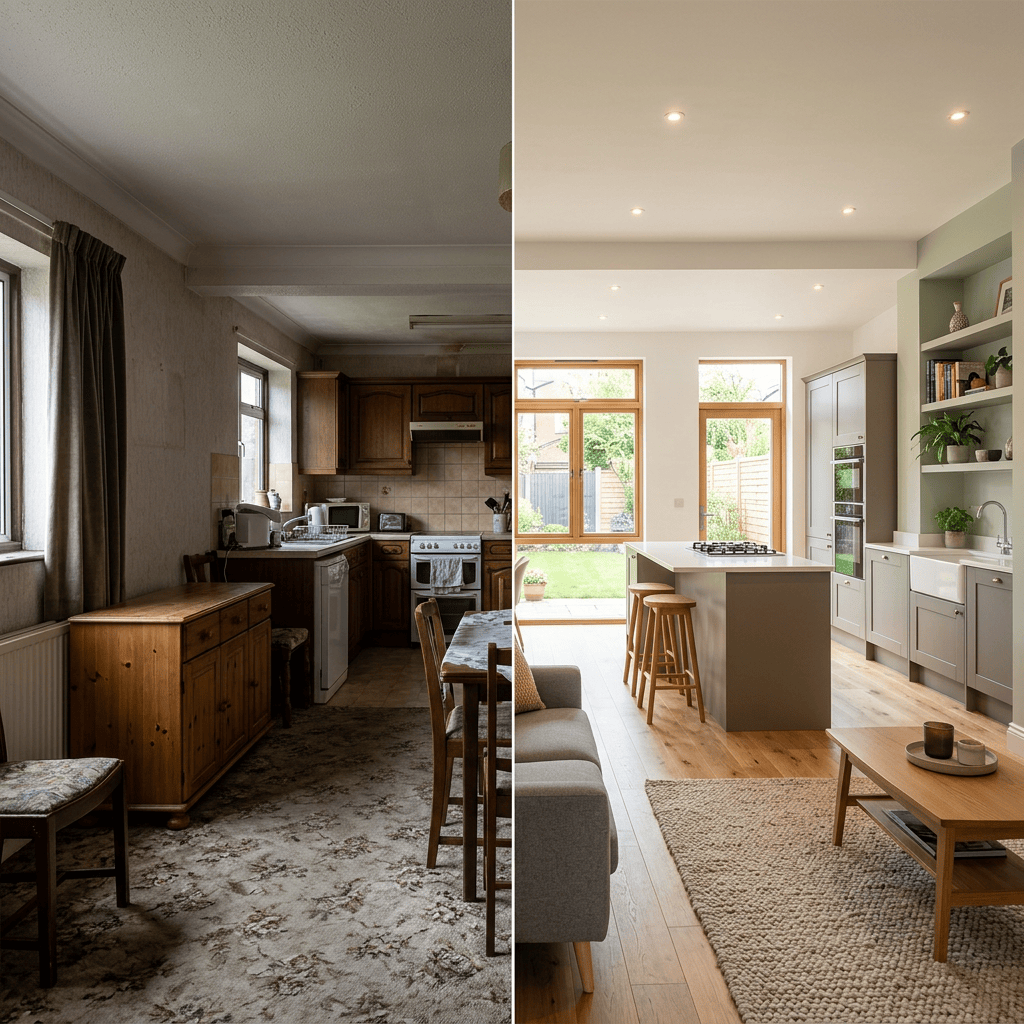
Layout Can Matter More Than Size
One of the biggest mistakes homeowners make is assuming that buyers only care about square footage.
They don’t.
A badly arranged 1,500 sq ft house can feel smaller than a well-designed 1,200 sq ft house.
Poor circulation, wasted corridors, dark rooms and badly positioned doors can significantly reduce the perceived quality of a property.
This is where relatively modest architectural changes can sometimes create surprisingly large improvements.
Removing or relocating a wall, opening a kitchen towards the garden or creating better storage may transform the way a house works without adding a single square metre.
Energy Efficiency Is Becoming More Visible
Energy performance is also becoming increasingly relevant.
Government data shows 377,000 EPCs were lodged for existing homes in England between July and September 2026, around 12% more than during the same period last year.
With household energy costs remaining a concern, buyers are paying greater attention to:
- Insulation
- Windows
- Heating systems
- Solar panels
- Heat pumps
- EPC ratings
A low EPC rating does not automatically make a property unattractive.
But buyers may increasingly calculate the cost of future improvements and reflect that in their offer.
What Should Sellers Do Before Listing?
The answer is not necessarily to spend £50,000 renovating.
Instead, focus on the improvements buyers will actually notice.
Repair obvious defects.
Improve lighting.
Declutter.
Repaint tired areas.
Clean and repair external spaces.
Make sure kitchens and bathrooms present well.
And, perhaps most importantly, price realistically from day one.
The objective should be to create a property that feels correctly priced for its condition.
Should You Renovate Before Selling?
Sometimes.
But not always.
Major extensions or expensive structural works undertaken purely for resale can be risky because you may not recover the full cost.
Smaller improvements can often achieve better returns.
For example:
- Better decoration
- Improved lighting
- Flooring
- Kitchen upgrades rather than replacement
- Improved storage
- Landscaping
- Energy-efficiency work
Before starting a major renovation, compare the likely increase in value with the actual cost.
What Does This Mean for Buyers?
For buyers, the current market can offer opportunities.
Properties that have been sitting unsold for several months may have sellers who are increasingly willing to negotiate.
But don’t simply look for the biggest discount.
Look for the best underlying property.
A tired home with:
- Good structure
- A strong location
- A good plot
- Extension potential
- A sensible layout
can be far more valuable long term than a newly decorated property with fundamental limitations.
What Does This Mean for Investors?
The same principle applies.
Investors should increasingly look for properties where the problem is fixable.
Bad decoration is fixable.
Poor kitchens are fixable.
Energy performance can often be improved.
Some layouts can be transformed.
But poor location, weak rental demand and major structural defects are much harder to overcome.
The best opportunities often arise when a property’s presentation is poor but its fundamentals are strong.
Final Thoughts
The current housing market is becoming increasingly selective.
Nationwide says annual house-price growth slowed to just 0.5% in October, the weakest rate since January 2024.
Buyers therefore feel less pressure to rush.
That means sellers need to work harder for attention.
The homes likely to perform best are not necessarily the largest or most expensive.
They are the ones that offer:
the right property, in the right location, at the right price.
And increasingly, good design is becoming part of that equation.
For homeowners considering selling, the key question is no longer simply:
“What is my house worth?”
It is:
“What would make a buyer choose my house over all the others?”
That is where value can still be created, even in a slower market.
Discover more from Move or Improve
Subscribe to get the latest posts sent to your email.


Leave a Reply