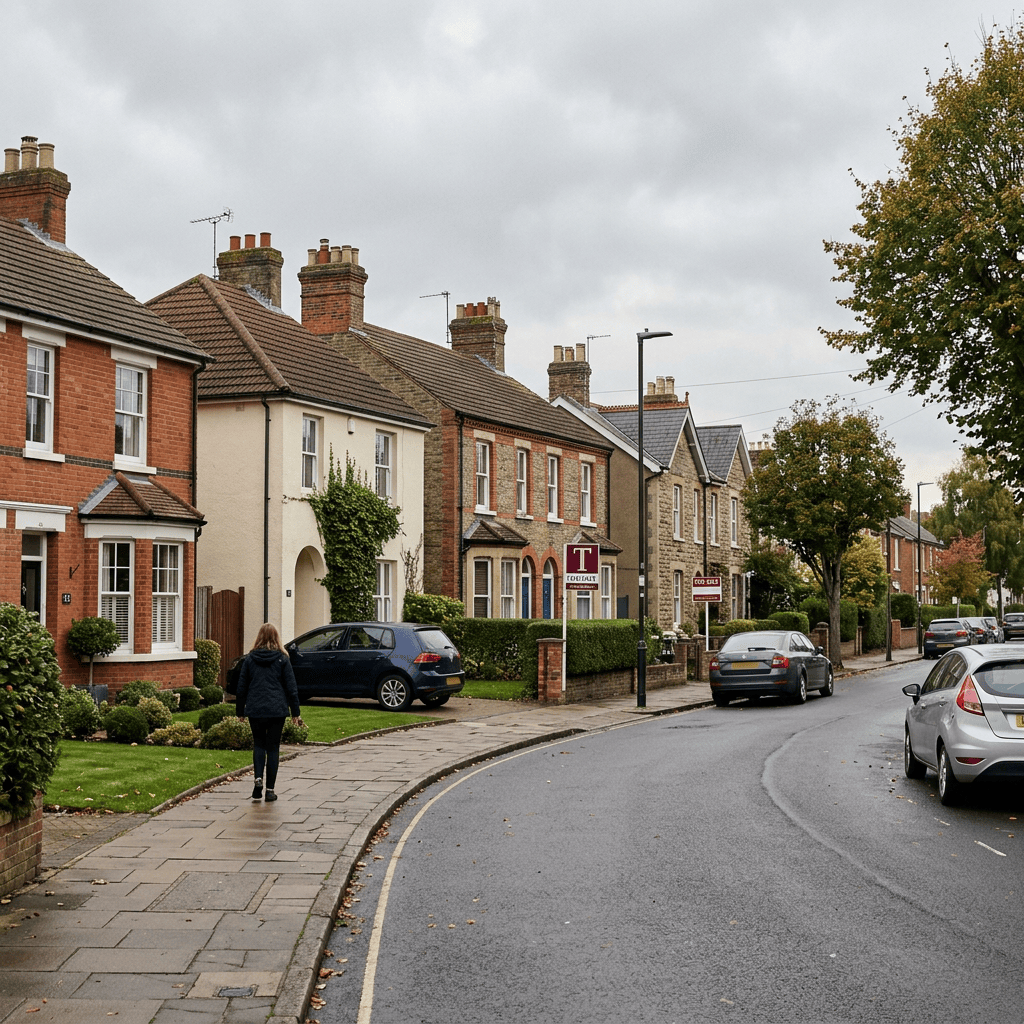
The UK housing market has just received two major shocks in the space of a few days.
First, the Bank of England increased Bank Rate from 3.75% to 4% on 5 November 2026, the first increase in more than three years.
Then new house-price data showed UK property values falling at their fastest rate for more than three years.
For homeowners, buyers and property investors, this raises an obvious question:
Is now a bad time to move or could this actually create an opportunity?
The answer depends very much on your position.
Why Have Interest Rates Gone Up Again?
The Bank of England voted 8 to1 to increase Bank Rate by 0.25 percentage points to 4%.
The reason is inflation.
UK CPI inflation reached 3.5% in September, and the Bank now expects it to rise to around 5% by the middle of 2027 if current energy pressures persist.
Higher oil and gas prices have pushed up household and business costs, and the Bank is trying to prevent those increases spreading into wider prices and wages.
The message is important:
Interest rates may not fall as quickly as many homeowners had hoped.
The next Bank of England decision is due on 17 December 2026.
House Prices Are Now Falling
At almost the same time, the latest Halifax/Lloyds data showed average UK house prices falling 0.6% in October.
The average property price fell to around £296,285.
Prices were also approximately 1.2% lower than a year earlier, representing the sharpest annual decline in around three years.
This was the fourth consecutive monthly fall.
London experienced the largest annual regional decline at approximately 3.1%, while the South East and South West were also weaker.
By contrast, Scotland, Wales and Northern Ireland have remained more resilient.
This reinforces something I have written about repeatedly:
There is no longer one UK housing market.
So Is the Property Market Crashing?
Not necessarily.
A falling market and a crashing market are two very different things.
Nationwide’s October index showed annual growth of 0.5%, while the official UK House Price Index still showed annual growth of 0.9% in August.
Different indices measure slightly different things and operate with different time lags.
But taken together, they clearly show the same trend:
The market is weakening.
Buyers are becoming more cautious.
Mortgage costs are higher.
More properties are competing for fewer buyers.
And sellers are having to become much more realistic about price.
What Does This Mean for Buyers?
Strangely, this could become a better market for certain buyers.
When prices are rapidly rising, buyers often feel under pressure to make quick decisions.
That pressure is disappearing.
Buyers can now increasingly:
- Negotiate harder
- Make lower offers
- Walk away from overpriced property
- Take more time over surveys
- Compare more properties
- Target homes requiring refurbishment
There is one significant problem, however:
Mortgage affordability.
A property may be £10,000 cheaper, but if your mortgage costs £200–£300 more each month, the saving can disappear very quickly.
That is why buyers need to assess the total cost of ownership, not simply the asking price.
Could Falling Prices Actually Be an Opportunity?
Yes, particularly if you have finance available and can negotiate.
Property markets often create their best opportunities when sentiment is weak.
You may start seeing:
- Motivated sellers
- Landlords exiting the market
- Properties sitting unsold for longer
- Developers offering incentives
- Refurbishment opportunities being discounted
- Auctions becoming more interesting
The critical distinction is between:
a property that is cheap because the market is temporarily weak
and;
a property that is cheap because there is something fundamentally wrong with it.
That is where due diligence becomes essential.
What Does This Mean for Homeowners Thinking of Moving?
This is where the Move or Improve question becomes particularly important.
Suppose you currently own a £400,000 property and want to move to a £600,000 property.
You are not simply paying another £200,000.
You may also face:
- Stamp Duty
- Estate-agent fees
- Solicitors
- Surveys
- Mortgage fees
- Removal costs
- Decorating
- Repairs to the new house
- A substantially larger mortgage
With interest rates now rising again, that larger mortgage becomes significantly more expensive over time.
So before moving, ask:
What could the same money achieve if I invested it in my existing home?
Could £50,000 – £100,000 Improve Your Current Home Instead?
For many homeowners, the answer could be significant.
Depending on the property, that money might fund:
- A rear extension
- Loft conversion
- Additional bedroom
- Home office
- Improved kitchen
- New bathroom
- Better insulation
- New windows
- Heat-pump installation
- Internal reconfiguration
The financial calculation is therefore no longer simply:
new house versus old house.
It is:
cost of moving versus value created by improving.
Why Renovation Could Become More Attractive
Higher interest rates change the economics.
If you already have:
- A lower fixed mortgage rate
- A house in a location you like
- Good schools nearby
- Family or community connections
- A suitable plot
then moving may mean sacrificing a favourable financial position.
Improving the existing home can potentially allow you to retain those advantages while creating the additional space you need.
That does not mean renovation is always better.
But it deserves serious consideration before taking on substantially more debt.
What Does This Mean for Sellers?
For sellers, the message is increasingly simple:
Pricing correctly matters more than ever.
Zoopla’s latest data shows the stock of homes for sale around 7% higher than a year ago, while agreed sales are approximately 7% lower.
That means buyers have more choice.
Homes that are priced realistically can still sell quickly. Zoopla says properties that do sell are finding buyers in around 44 days on average.
But unrealistic asking prices risk leaving properties sitting on the market.
In today’s market, buyers can compare alternatives very easily.
What About Property Investors?
The situation is particularly interesting for investors.
There are now several forces acting simultaneously:
- Higher mortgage costs
- Falling house prices
- Higher taxes on personally owned rental income from April 2027
- Strong rental demand in many regions
- Potential landlord disposals
This could lead some existing landlords to sell.
For well-capitalised investors, that could create buying opportunities.
But traditional highly leveraged buy-to-let becomes harder when borrowing costs rise.
That means investors increasingly need to concentrate on:
- Higher yields
- Buying below market value
- Refurbishment
- Mixed-use property
- Commercial/residential investments
- Strong regional rental markets
- Creating additional accommodation
- Improving EPC ratings
Simply buying a finished property at a low yield and hoping the market rises may no longer be enough.
Is the North Better Positioned?
Potentially.
Higher mortgage costs disproportionately affect expensive markets.
That helps explain why London and southern England have experienced greater price pressure.
More affordable areas can offer:
- Lower purchase prices
- Smaller mortgages
- Higher rental yields
- Better cash flow
But investors should avoid assuming that every northern property is automatically a good investment.
City, neighbourhood and even street-level demand still matter enormously.
Could We See More Landlords Selling?
Possibly.
The recent Budget confirmed that from April 2027, individuals receiving property income will face dedicated tax rates of:
24% basic rate
44% higher rate
49% additional rate
That creates another pressure on personally owned buy-to-let portfolios.
Some landlords may continue holding because rental demand remains strong.
Others may decide that their return no longer justifies the taxation, regulatory burden and borrowing costs.
If this results in more properties reaching the market, it could create opportunities for owner-occupiers and professionally structured investors.
What Should You Do Right Now?
The worst response is probably panic.
A changing market requires analysis rather than emotion.
If you are buying:
Negotiate and be patient.
If you are selling:
Price realistically.
If you are remortgaging:
Review options well before your fixed term expires.
If you are investing:
Prioritise yield and value creation.
If you are considering moving:
Calculate exactly what moving will cost before deciding.
If you already like your home and location:
Investigate what can be achieved through renovation.
The Bigger Picture
The Bank of England has now made clear that the inflation problem is not over.
Bank Rate is 4%, inflation is 3.5%, and the Bank expects inflation could reach around 5% by mid-2027.
That means the property market may remain challenging for some time.
But difficult markets also create opportunities.
During rapidly rising markets, almost everything looks like a good investment.
Slower markets reveal the difference between:
good property and bad property,
good design and poor design,
and
real value and inflated pricing.
Final Thoughts
For several years, many homeowners assumed that the solution to needing more space was simply to move.
But with house prices weakening and mortgage costs rising again, that assumption deserves to be challenged.
Buying may become attractive where sellers are motivated.
Investors may find better deals.
But homeowners with a good existing property may discover that the smartest financial decision is simply to make that property work harder.
Before you put your home on the market, ask yourself one question:
Would I rather spend the money on buying a different house or use it to create the house I actually want?
In November 2026, that question may be more important than ever.
Discover more from Move or Improve
Subscribe to get the latest posts sent to your email.


Leave a Reply