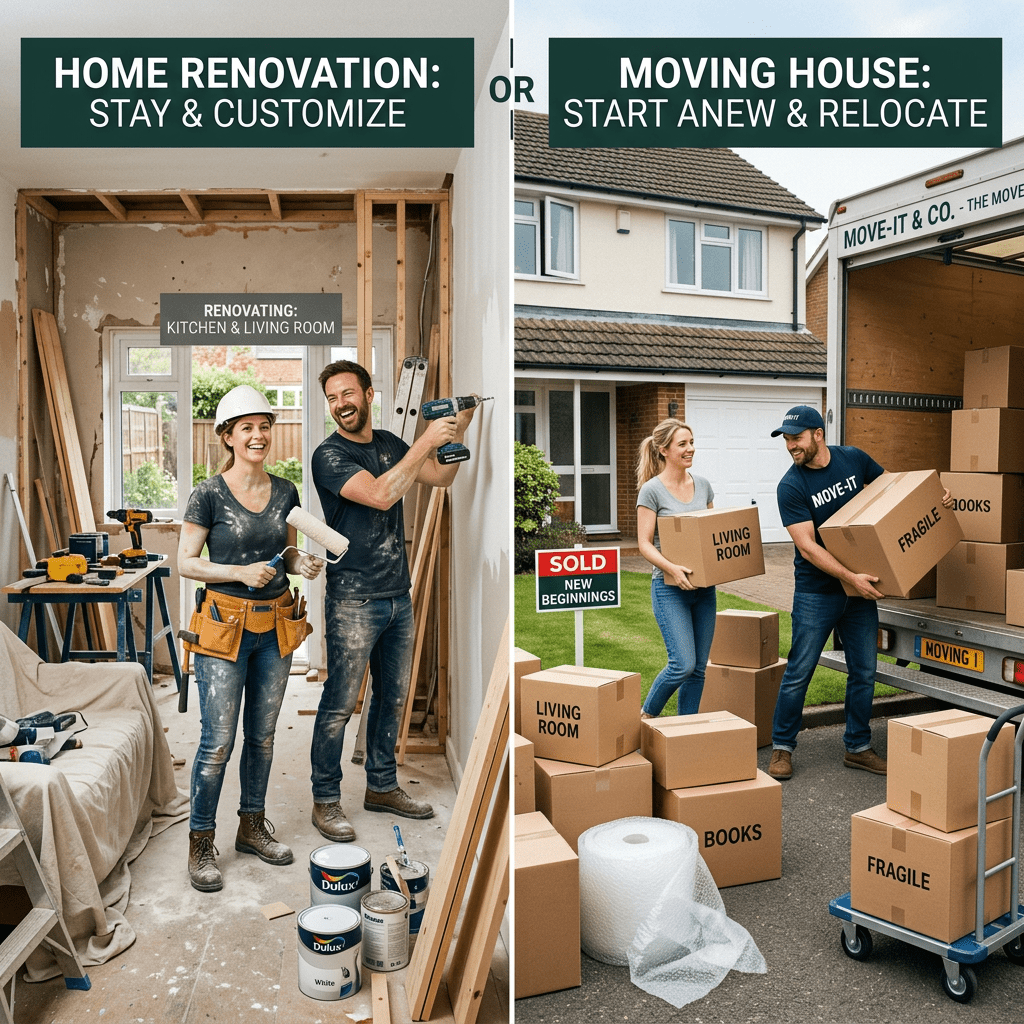
Across the UK, a noticeable shift is taking place in the housing market.
Rather than packing boxes, paying stamp duty, and competing for increasingly expensive homes, many homeowners are choosing a different route:
They are staying put and renovating instead.
From an architectural perspective, this trend has been building for several years but in 2026 it has become far more pronounced. Rising transaction costs, changing lifestyle priorities, energy-efficiency pressures and the growing desire for long-term homes are all reshaping how people think about where and how they live.
For readers of Move or Improve, the key question is no longer simply “Can we move?” but increasingly:
“Would improving our existing home actually make more sense?”
This article explores why renovation is becoming the preferred option for so many households in 2026.
The Cost of Moving Has Become Harder to Justify
One of the biggest drivers behind the renovation trend is simple economics.
Moving house now involves significant costs beyond the purchase price itself, including:
- Stamp Duty Land Tax.
- Estate agent fees.
- Solicitors and conveyancing.
- Mortgage arrangement fees
- Surveys and valuations.
- Removal costs.
- Immediate redecorating or repairs.
For many households, particularly in higher-value areas, these expenses can easily reach tens of thousands of pounds.
Increasingly, homeowners are asking whether that money would be better invested in:
- Extensions,
- Loft conversions,
- Energy retrofits, or;
- Layout improvements.
In many cases, the answer is yes.
People Want Better Homes, Not Just Bigger Ones
The pandemic years permanently altered how people use their homes.
In 2026, buyers and renovators alike are prioritising:
- Flexible layouts,
- Home-working spaces,
- Wellness areas,
- Stronger connections to gardens, and;
- Energy-efficient living.
Architects are finding that many existing houses already contain enough space but are simply arranged poorly.
Rather than moving to gain another room, homeowners are increasingly choosing to:
- Reconfigure layouts,
- Improve daylight,
- Open kitchens to gardens,
- Convert lofts, or;
- Add garden studios.
The emphasis has shifted from more space to better-performing space.
Energy Efficiency Is Now a Major Motivation
Rising energy costs and growing awareness of sustainability are also changing behaviour.
Older homes with poor insulation and outdated heating systems are becoming more expensive to run and less attractive to buyers.
As a result, many homeowners are investing in:
- Insulation upgrades,
- Heat pumps,
- Solar panels,
- Airtightness improvements, and;
- High-performance glazing.
These improvements not only reduce bills but often make homes dramatically more comfortable.
For many households, retrofitting their existing property now feels more rational than buying another house that may require similar upgrades.
Homeowners Are Thinking Longer-Term
Another major shift is psychological.
People are moving less frequently than they once did. Instead of viewing houses as short-term stepping stones, many now want a “forever home” capable of adapting over time.
Architects are increasingly designing:
- Flexible layouts,
- Future-proofed spaces,
- Accessible bathrooms,
- Multi-functional rooms, and;
- Extension strategies that can evolve with family life.
This long-term thinking naturally encourages investment in improvement rather than repeated relocation.
Planning and Permitted Development Have Opened Opportunities
Permitted development rights continue to make many renovation projects faster and less risky than homeowners expect.
Rear extensions, loft conversions, garage conversions, and garden rooms can often proceed without full planning permission, provided they comply with regulations.
This has made upgrading more accessible and has encouraged many households to explore possibilities before considering a move.
The Emotional Pull of Staying Put
Location remains one of the most valuable parts of any property.
Many people:
- Love their neighbourhood,
- Value school catchments,
- Rely on local support networks, or;
- Simply do not want to leave familiar surroundings.
Renovation allows homeowners to preserve these connections while reshaping the house around modern life.
For families especially, this emotional stability is often just as important as financial logic.
Wellness and Lifestyle Design Are Reshaping Renovation
Another growing influence in 2026 is the desire for healthier homes.
Architects are seeing rising demand for:
- Wellness rooms,
- Biophilic design,
- Improved natural light,
- Air-quality upgrades,
- Spa-style bathrooms, and;
- Calm, minimalist interiors.
These lifestyle-driven improvements often create a stronger emotional attachment to the home itself, making moving feel less necessary.
When Moving Still Makes Sense
Renovation is not always the right answer.
Moving may still be more sensible when:
- Plots severely limit extension,
- Structural problems are extensive,
- Accessibility needs cannot be met, or;
- The location itself no longer works.
The key is understanding whether the real problem is the house or something architecture cannot fix.
Final Thoughts
In 2026, more homeowners are renovating instead of moving because the balance has changed.
High transaction costs, energy-efficiency pressures, hybrid working, and the desire for long-term adaptable homes are all making improvement increasingly attractive.
For many households, the smartest investment is no longer buying a different property but unlocking the potential of the one they already own.
As always, the right decision depends on:
- Budget,
- Location,
- Planning potential,
- Lifestyle priorities, and;
- Long-term goals.
But one thing is clear: the era of moving every few years appears to be giving way to a more thoughtful approach, one focused on creating homes worth staying in.
Discover more from Move or Improve
Subscribe to get the latest posts sent to your email.


Leave a Reply