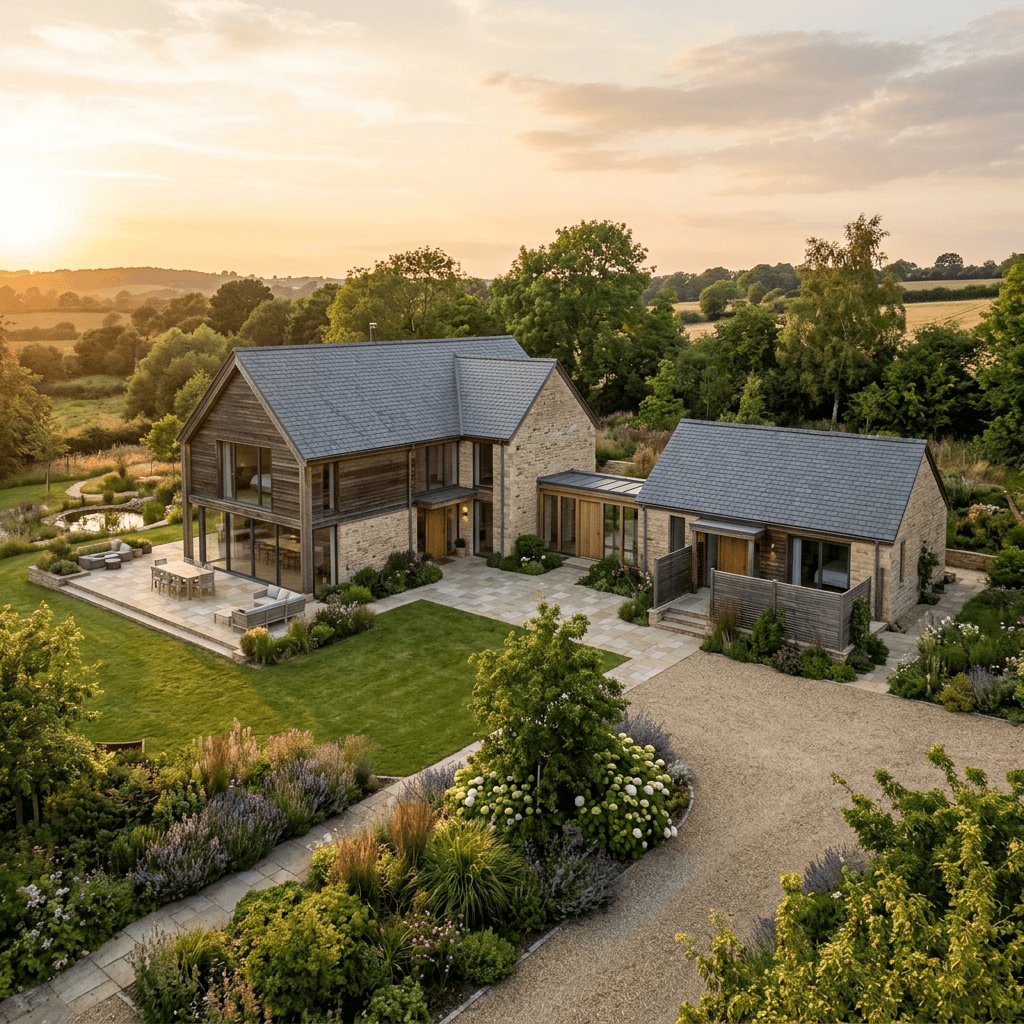
A new property trend is emerging across Britain.
Millions of middle-aged homeowners are no longer simply maintaining their own homes.
They are also helping ageing parents look after theirs.
Zoopla has described this group as Britain’s “Property Sandwich Generation” people caught between their own housing responsibilities and those of older parents.
For many families, this raises a difficult but increasingly important question:
Should older parents stay and adapt their home, downsize, or move closer to family?
The Hidden Cost of Maintaining Two Homes
New research suggests almost two-thirds of homeowners aged 35–65 with a homeowning parent aged 65+ helped maintain or manage their parent’s property during the past year.
Among those helping, the average contribution was around £630 a year, alongside more than five hours a month spent dealing with the property.
The support ranges from:
- Gardening
- Cleaning
- DIY
- Decorating
- Organising trades
- Repairs
- General maintenance
More than four in ten said they sometimes felt as though they were responsible for maintaining two homes rather than one.
That is not just a financial issue.
It is a time issue.
And for many families it eventually becomes a housing issue.
The Home May No Longer Suit the Owner
A house that worked perfectly at 45 may be far less suitable at 75 or 85.
Common problems include:
- Too many stairs
- Bathrooms on the wrong floor
- Large gardens
- Poor insulation
- Difficult access
- Excessive maintenance
- Underused bedrooms
- Long distances from family or services
Yet many older homeowners understandably want to stay.
The family home may contain decades of memories.
The neighbourhood may provide friends, familiarity and independence.
So the answer is not automatically:
“Sell and move.”
Sometimes the better answer is:
“Adapt and stay.”
Could the Home Be Future-Proofed Instead?
This is where good design becomes important.
A property may be capable of adapting to changing needs without requiring a full move.
Depending on the house, improvements might include:
Creating a ground-floor bedroom
A study, dining room or extension could potentially become accessible sleeping accommodation.
Adding a downstairs shower room
This can dramatically improve future usability.
Improving access
Removing steps, adjusting thresholds or creating wider circulation can make everyday life easier.
Reconfiguring the ground floor
Better layouts can reduce unnecessary movement around the house.
Improving lighting
Good natural and artificial light becomes increasingly important as we age.
Reducing maintenance
Better materials, simpler gardens and modern services can reduce ongoing upkeep.
The objective is not to make a home look institutional.
It is to make it work better.
What About Downsizing?
For some homeowners, downsizing may still be the right decision.
A smaller home can offer:
- Lower maintenance
- Lower energy bills
- Less garden work
- Released equity
- Easier access
- A simpler lifestyle
But downsizing does not always release as much money as people expect.
A high-quality bungalow or accessible apartment in a desirable location can be expensive.
Then there are:
- Estate-agent fees
- Stamp Duty
- Solicitors
- Surveys
- Removals
- New furniture
- Service charges in some apartments
That means families should compare the true cost of moving with the cost of adapting.
One in Five Families Have Considered Moving Closer
The new research found that around 20% of those helping ageing parents had moved
or considered moving closer to them because of property-maintenance needs.
That rises to 32% where the parent’s home requires repairs or updating.
That is a major decision.
Before uprooting an entire family, it may be worth asking whether the parent’s home could be modified to reduce the amount of support required.
Sometimes relatively modest changes can allow someone to remain independent for much longer.
The Conversation Many Families Avoid
Perhaps the most striking finding is that 47% have never discussed whether their parents’ current home will actually suit their future needs.
That means many families may be waiting until a crisis forces the conversation.
A fall.
A major repair.
Illness.
Loss of mobility.
Or sudden pressure to move.
It is far better to discuss these issues while everyone still has choices.
Should You Improve Before You Need To?
In many cases, yes.
Future-proofing is often easier and cheaper when incorporated into planned refurbishment.
If you are already:
- Replacing a bathroom
- Renovating a kitchen
- Extending
- Replacing floors
- Improving heating
then it may be sensible to think about future accessibility at the same time.
For example:
A new bathroom could include a walk-in shower.
A kitchen could be designed with easier circulation.
An extension could create a flexible room capable of becoming a bedroom later.
Good architecture anticipates change.
Could Multigenerational Living Increase?
This may also become a bigger trend.
Higher house prices, mortgage costs and care costs could encourage more families to consider living closer together — or even under one roof.
That could mean:
- Annexes
- Garden accommodation
- Extended homes
- Converted garages
- Separate living areas within larger houses
Subject to planning, Building Regulations and the individual site, these approaches can create independence while keeping family support nearby.
For some households, that may ultimately be more practical than maintaining two completely separate homes.
What Should Families Consider First?
Before deciding whether an ageing parent should move or improve, I would look at five things:
1. Accessibility
Can the house still work if mobility declines?
2. Maintenance
Is the property becoming too demanding?
3. Location
Are shops, doctors, transport and family close enough?
4. Cost
Would adapting the house be cheaper than moving?
5. Long-term flexibility
Could today’s improvement still work in ten or twenty years?
The answer will be different for every family.
What About Inheritance?
Nearly two-thirds of those surveyed expect to inherit some or all of their parent’s property.
That can make decisions emotionally and financially complicated.
But a home should not remain unsuitable simply because it may eventually form part of an inheritance.
The first priority should be making the property work safely and comfortably for the person living there now.
Final Thoughts
The Property Sandwich Generation highlights something many families are already experiencing:
Housing decisions increasingly involve more than one generation.
Older parents want independence.
Their children want them safe.
Both generations may be worried about cost.
And everyone may be emotionally attached to the family home.
That is why the decision should not automatically be:
move or stay.
There is often a third option:
adapt.
A well-designed home can evolve with its occupants.
And in many cases, a thoughtful renovation could allow someone to remain in the neighbourhood and home they love while reducing the burden on the rest of the family.
The most important thing is to start the conversation before circumstances force the decision.
Because when it comes to ageing and property, planning early usually creates far more choices later.
Discover more from Move or Improve
Subscribe to get the latest posts sent to your email.


Leave a Reply