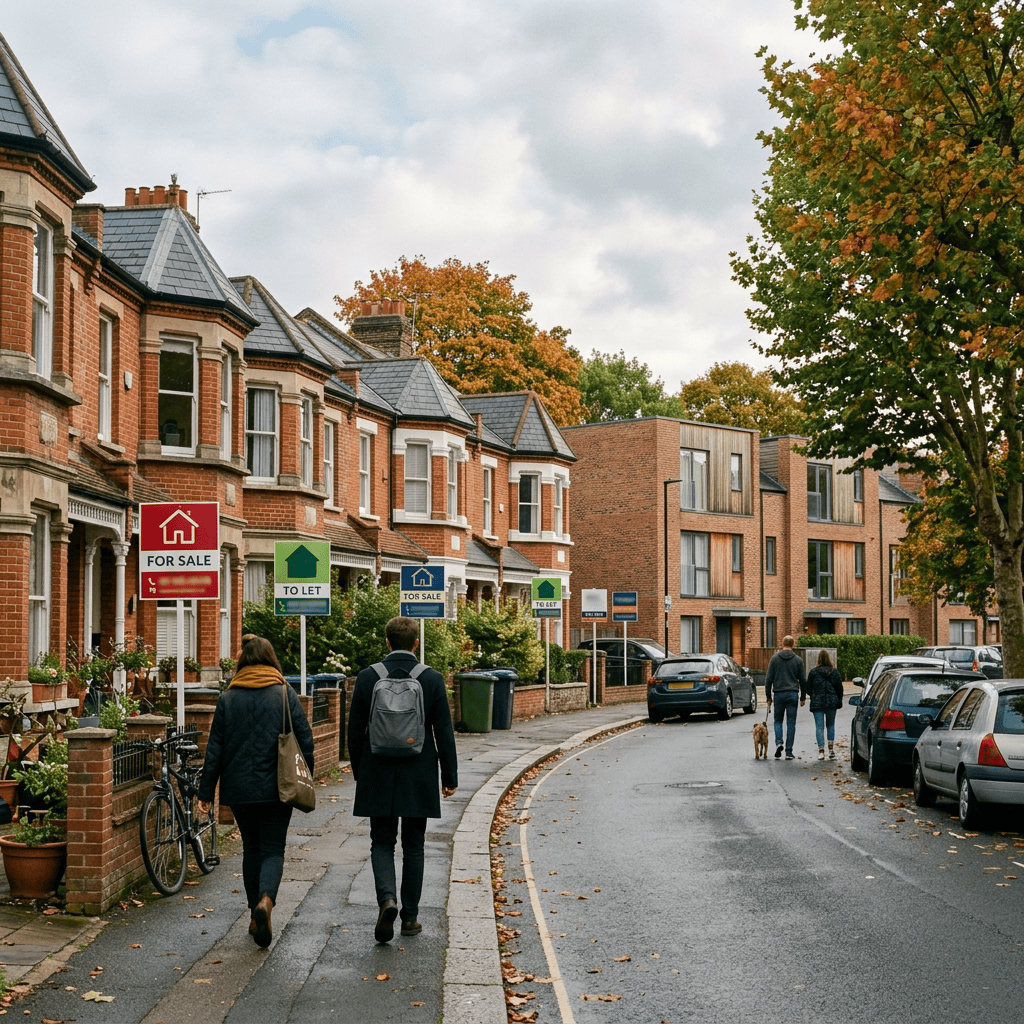
September has brought a fascinating mixture of good and bad news for the UK housing market.
House-price growth remains positive but subdued. Buyers have returned to the market surprisingly strongly after the summer holidays, rents continue to rise, and there are tentative signs that the recent housing slowdown may be beginning to stabilise.
However, there is a significant new challenge.
UK inflation increased to 3.1% in August, largely because of higher energy and fuel costs. That makes the outlook for mortgage rates less comfortable than it appeared earlier in the year and puts tomorrow’s Bank of England interest-rate decision firmly in the spotlight.
For readers of Move or Improve, the September market reinforces an increasingly important point:
This is neither a booming market nor a collapsing one. It is a highly selective market in which affordability, location, energy performance and the quality of individual homes matter more than ever.
Essential Insights for Buyers & Investors
The latest official figures show that average UK house prices reached approximately £273,000 in July 2026, around 1.4% higher than a year earlier.
Nationwide’s more recent August index also recorded modest growth, with prices increasing 0.2% during the month and 1.6% annually.
These figures point towards resilience rather than rapid growth.
Meanwhile, something interesting has happened in September.
Rightmove reported that buyer demand jumped 5% during the first week of September, compared with an average increase of only 0.4% at the same point during the previous five years.
London recorded a particularly strong 9% increase, while the South West was up 8%.
So buyers have returned but they are returning to a market in which they can afford to be selective.
UK Housing Market Snapshot
As of mid-September:
- Average UK house prices are approximately £273,000.
- Official annual house-price growth has slowed to around 1.4%.
- Nationwide’s August measure showed annual growth of 1.6%.
- Buyer demand increased sharply at the beginning of September.
- Private rents are continuing to rise faster than house prices.
- Mortgage affordability remains one of the biggest barriers to transactions.
- Regional differences remain substantial.
- Sellers need to be increasingly realistic about asking prices.
Perhaps most importantly, the housing market appears to be finding a new equilibrium rather than moving strongly in either direction.
Rents Are Rising Faster Than House Prices
One of the most striking features of the current market is what is happening in the rental sector.
The latest ONS figures show that average UK private rents reached approximately £1,400 per month in August, an increase of 3.8% over the previous year.
That compares with annual house-price growth of just 1.4%.
In England, average rents reached approximately £1,459 per month.
The North East and North West recorded some of the strongest rental inflation in England, at around 5.8%.
For investors, this strengthens the attraction of areas where:
- Purchase prices remain relatively affordable
- Employment is strong
- Rental demand is established
- Housing supply is limited
- Properties can be improved strategically
However, rising rents should never substitute for proper investment analysis. Finance costs, maintenance, void periods, taxation and refurbishment expenses must all be incorporated into any appraisal.
Is the Housing Slowdown Beginning to Bottom Out?
There are tentative signs that conditions may be improving.
The Royal Institution of Chartered Surveyors reported that buyer enquiries improved in August to their strongest reading since January.
Measures of agreed sales and prices also became slightly less negative.
This does not mean a new housing boom is beginning.
Instead, it suggests the market may be gradually finding its footing after several difficult months.
For buyers and sellers, that distinction is important.
A stabilising market can provide opportunities without creating the frantic competition associated with rapidly rising prices.
The Biggest New Issue: Inflation Has Risen to 3.1%
Today’s inflation figures introduce an important new uncertainty.
UK CPI inflation increased to 3.1% in August, its highest level for five months.
Higher energy costs, fuel prices and airfares were significant contributors.
Underlying inflation was more reassuring, with core inflation remaining at 2.6% and services inflation at 3.4%.
Nevertheless, headline inflation is now considerably above the Bank of England’s 2% target.
That matters enormously for housing.
If inflation remains persistent, mortgage rates could stay higher for longer — or potentially rise.
What Happens to Interest Rates Next?
Bank Rate currently stands at 3.75%.
The Bank of England announces its next decision on 17 September, one day after this newsletter update.
Most economists currently expect the Bank to leave rates unchanged at this meeting.
However, the debate has changed considerably.
Earlier in the year, discussion centred on when interest rates might fall.
Now, rising energy costs have led financial markets and some economists to consider whether further increases might eventually become necessary.
For homeowners, that means it would be unwise to base a move or renovation decision on the assumption that cheap mortgages are about to return.
Affordability should be tested using realistic — and preferably slightly stressed — interest-rate assumptions.
What Does This Mean for Buyers?
September presents a potentially interesting buying environment.
More purchasers are returning to the market, but sellers do not necessarily have the upper hand.
Buyers should concentrate on value rather than simply asking price.
Consider:
- Recent sold prices
- Time on market
- Previous price reductions
- EPC rating
- Structural condition
- Potential renovation costs
- Planning possibilities
- Local ceiling values
Properties requiring refurbishment can present opportunities, particularly where cosmetic condition discourages less experienced purchasers.
But the price must leave enough margin for the work.
What Does This Mean for Sellers?
The return of buyers in September is positive news.
But today’s buyer is highly informed.
Properties that are realistically priced and offer:
- Good natural light
- Sensible layouts
- Energy efficiency
- Good maintenance
- Attractive gardens
- Flexible working space
can still perform strongly.
Overpricing remains risky.
In a market with greater choice, a property sitting unsold for several months can quickly acquire the perception that something is wrong with it.
Realistic pricing from day one is increasingly important.
For Movers & Upsizers: Run the Numbers Carefully
The move-or-improve calculation has arguably become even more important.
Imagine moving from a £450,000 property to a £600,000 house.
The financial difference is not simply £150,000.
You must also consider:
- Stamp Duty
- Estate-agent fees
- Solicitors
- Surveys
- Mortgage fees
- Removals
- Immediate repairs
- Decorating
- Potentially much greater mortgage interest
Now compare that with investing perhaps £50,000, £75,000 or £100,000 into the house you already own.
Could that create:
- Another bedroom?
- A loft conversion?
- A better kitchen?
- An additional bathroom?
- A home office?
- Improved energy performance?
- Better garden connections?
For homeowners who already love their neighbourhood, that comparison can be illuminating.
What About the New Prime Minister?
Prime Minister Andy Burnham’s government continues to emphasise housing supply, regional devolution and investment outside London.
Those policies could ultimately influence where homes are built and where infrastructure and regeneration investment takes place.
However, the government’s immediate economic challenge has become more difficult.
Higher inflation, increased energy costs and elevated government borrowing costs reduce the amount of financial flexibility available ahead of the 28 October Budget.
For the housing market, that means attention will increasingly turn to what the government actually delivers on housing, infrastructure, planning and taxation rather than simply policy announcements.
There has also been considerable debate within the housebuilding industry about Stamp Duty, with some major developers arguing that reform could stimulate transactions.
At present, however, homeowners and investors should make decisions based on the current tax regime rather than assuming future reductions.
Regional Markets Matter More Than the National Average
One of the recurring themes of 2026 has been the widening difference between regions.
A UK average of 1.4% house-price growth tells you remarkably little about what is happening on one street in Liverpool, Manchester, London, Birmingham or Bristol.
The same applies to rents.
September’s ONS figures show some of the strongest rental growth in the North East and North West.
Regional investment, affordability and regeneration could therefore become increasingly important over the next few years.
But property decisions must ultimately be hyper-local.
Look at:
- Individual streets
- Comparable sales
- Schools
- Hospitals
- Universities
- Employment
- Transport
- Rental demand
- Regeneration programmes
A good postcode can still contain poor investments and an overlooked street can sometimes contain excellent opportunities.
Investor Insight: Value Creation Beats Speculation
The current market increasingly favours investors who can create value rather than simply wait for prices to rise.
That means opportunities in:
- Refurbishment
- Energy-efficiency improvements
- Layout reconfiguration
- Underperforming rental properties
- Properties with planning potential
- Strong regional rental markets
A property bought well and improved intelligently can potentially create equity even in a relatively flat national market.
That is a fundamentally stronger strategy than relying solely on general house-price inflation.
The September Positives
There are several encouraging developments:
- Buyer demand has returned strongly after summer.
- House prices remain resilient.
- RICS data suggests the slowdown may be stabilising.
- Rental demand remains strong.
- Buyers have greater negotiating opportunities.
- Regional markets continue to offer areas of growth.
The September Risks
There are also significant uncertainties:
- Inflation has risen to 3.1%.
- Energy costs remain volatile.
- Mortgage rates may stay higher for longer.
- House-price growth remains subdued.
- Construction costs remain significant.
- Planning delays continue to restrict new supply.
- The October Budget could alter confidence and taxation expectations.
This is therefore a market that rewards careful analysis rather than speculation.
Key Takeaways
- UK average house prices are approximately £273,000.
- Official annual house-price growth slowed to 1.4% in July.
- Nationwide recorded 1.6% annual growth in August.
- UK private rents rose 3.8% annually to around £1,400 per month.
- Buyer demand increased 5% in the first week of September.
- RICS is seeing early indications that the market slowdown may be stabilising.
- UK inflation has risen to 3.1%.
- Bank Rate remains 3.75% ahead of the 17 September decision.
- Mortgage affordability remains the principal constraint.
- Regional differences continue to widen.
- Renovation remains a compelling alternative to trading up.
Final Thoughts
September 2026 is proving to be a month of contradictions.
Buyers are returning but prices are barely moving.
Rents are increasing faster than property values.
The housing slowdown may be stabilising, while inflation is creating new uncertainty around mortgage rates.
And government ambitions to increase housing supply are colliding with difficult economic conditions and continued constraints within the construction industry.
For homeowners, however, this market creates an opportunity to think more strategically.
Before deciding to move, examine what you already own.
Could better design unlock unused space?
Could energy improvements make the house substantially cheaper and more comfortable to run?
Could £50,000 spent improving your current property deliver more lifestyle value than £50,000 disappearing into the costs associated with moving?
There will never be a universal answer.
But in September 2026, perhaps more than at any point this year, the smartest housing decision is not necessarily about predicting whether prices will rise or fall.
It is about understanding where your money can create the greatest value in the next property, or in the home you already have.
Discover more from Move or Improve
Subscribe to get the latest posts sent to your email.


Leave a Reply